

Guido Crepax
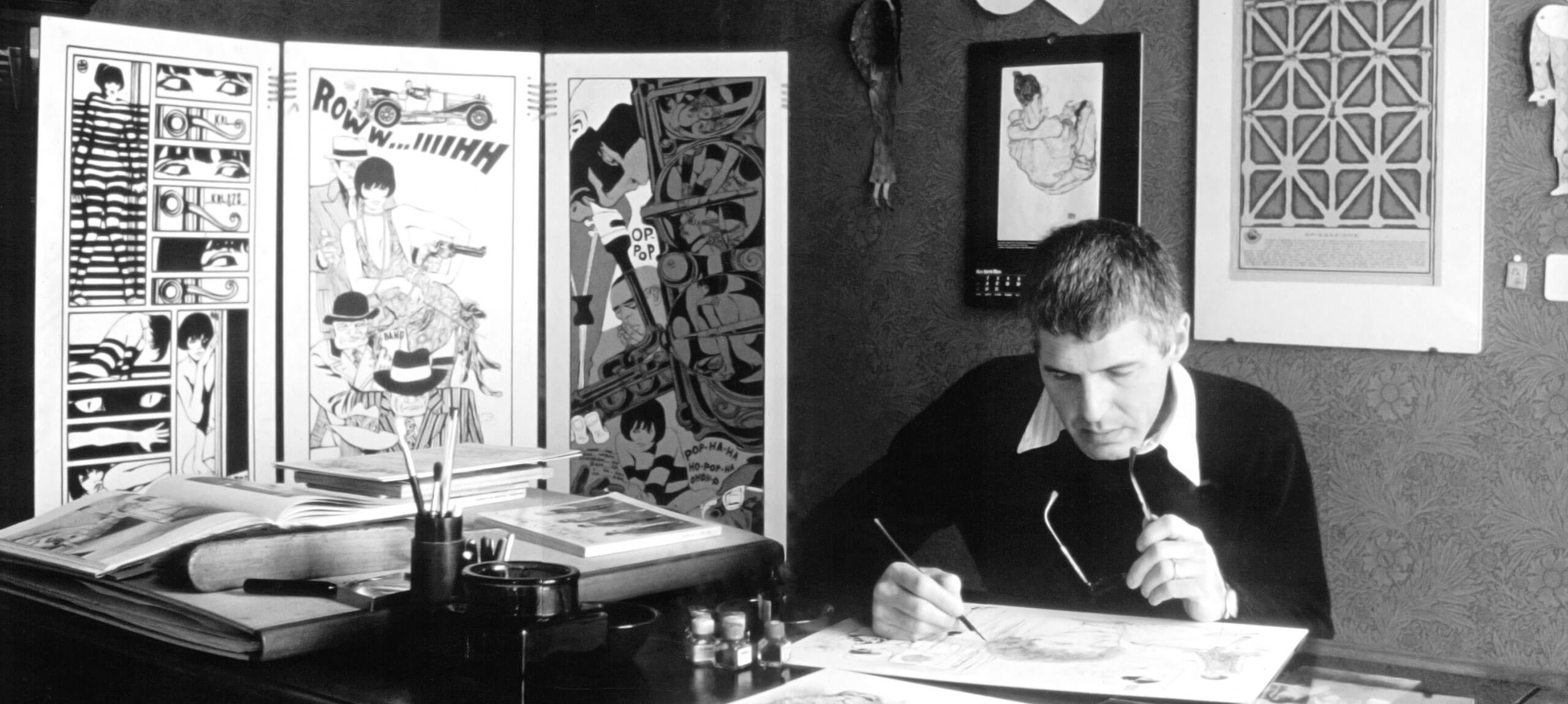

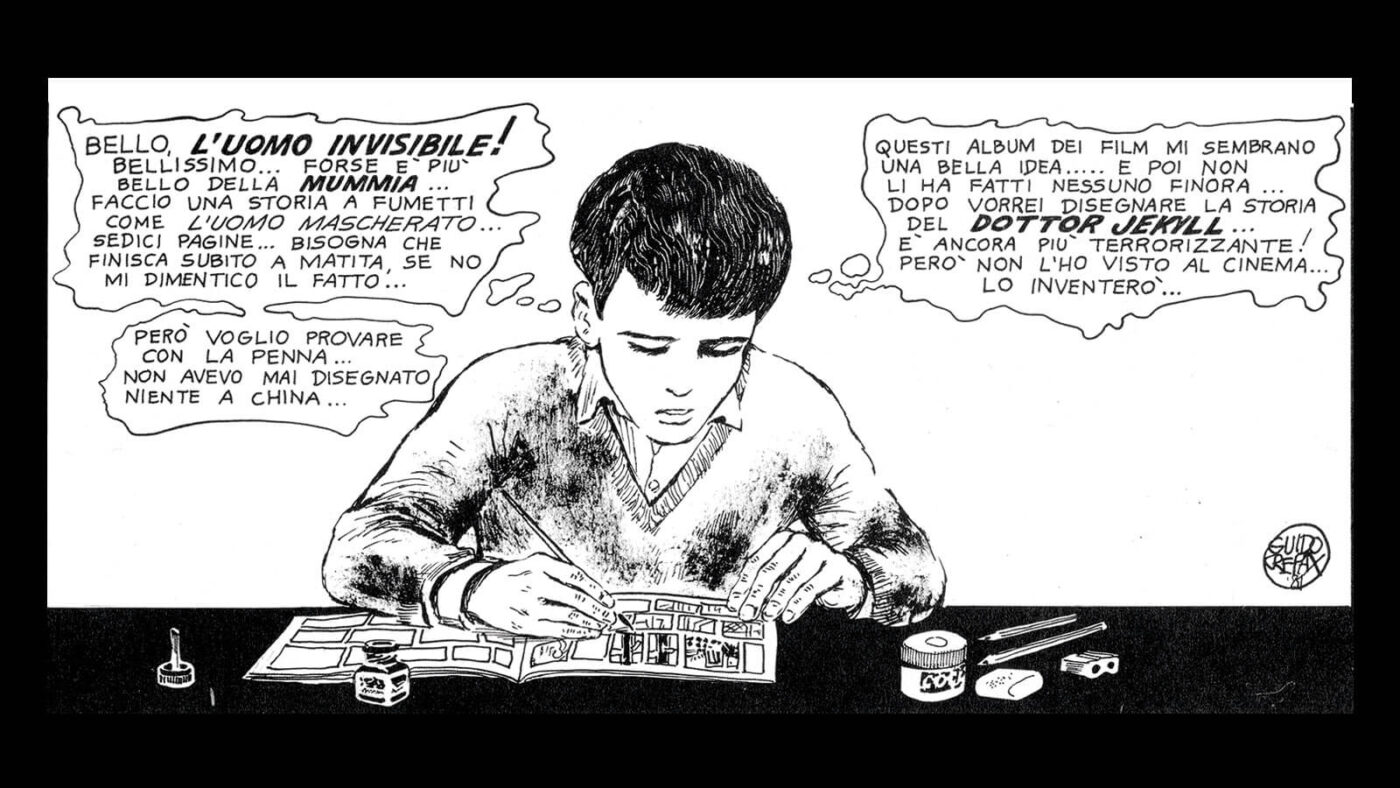
Born in Milan in 1933, Guido Crepax is one of Italy’s most important comic artists. He began at a very young age, creating his first comic story at only twelve.
After graduating in architecture, he devoted himself to drawing — first as an illustrator of vinyl record covers (he designed more than 300 of them) and later as an advertising graphic designer, signing campaigns for Shell, Campari, Rizzoli, Dunlop, Terital, and subsequently for Volkswagen, Iveco, Breil, Fuji, and Honda.
In 1965, thanks to the magazine Linus, he returned to comics to create the character who would make him known worldwide: Valentina — one of the few female protagonists in the world of comics, and the only one to have aged alongside her creator.
In the following years, other heroines would join her: from Bianca to Anita, from Giulietta to Francesca. His comic adaptations of literary classics are meticulous and refined: from Emmanuelle to Histoire d’O, from Justine to Venus in Furs, from Dracula to Frankenstein, from Dr Jekyll and Mr Hyde to The Turn of the Screw, from Poe to Kafka.
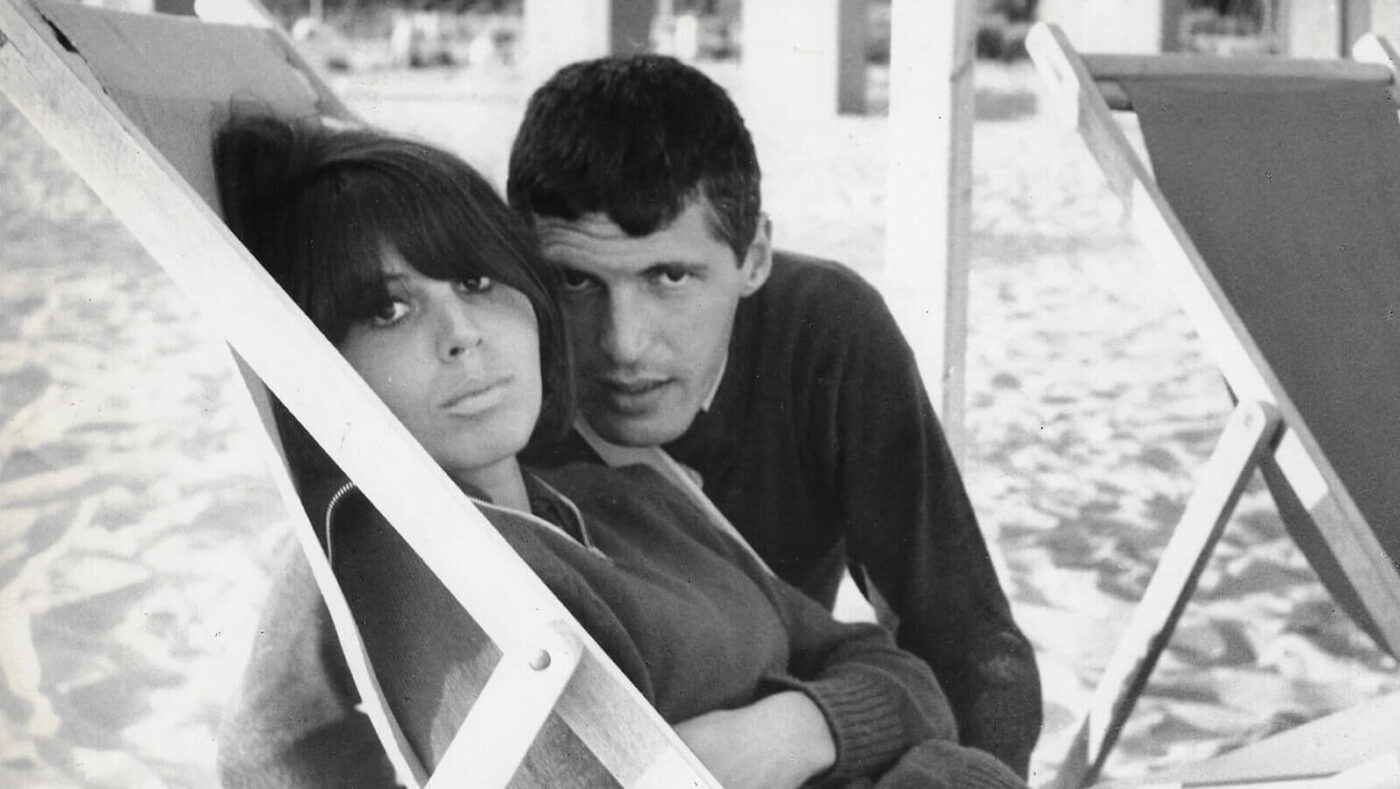
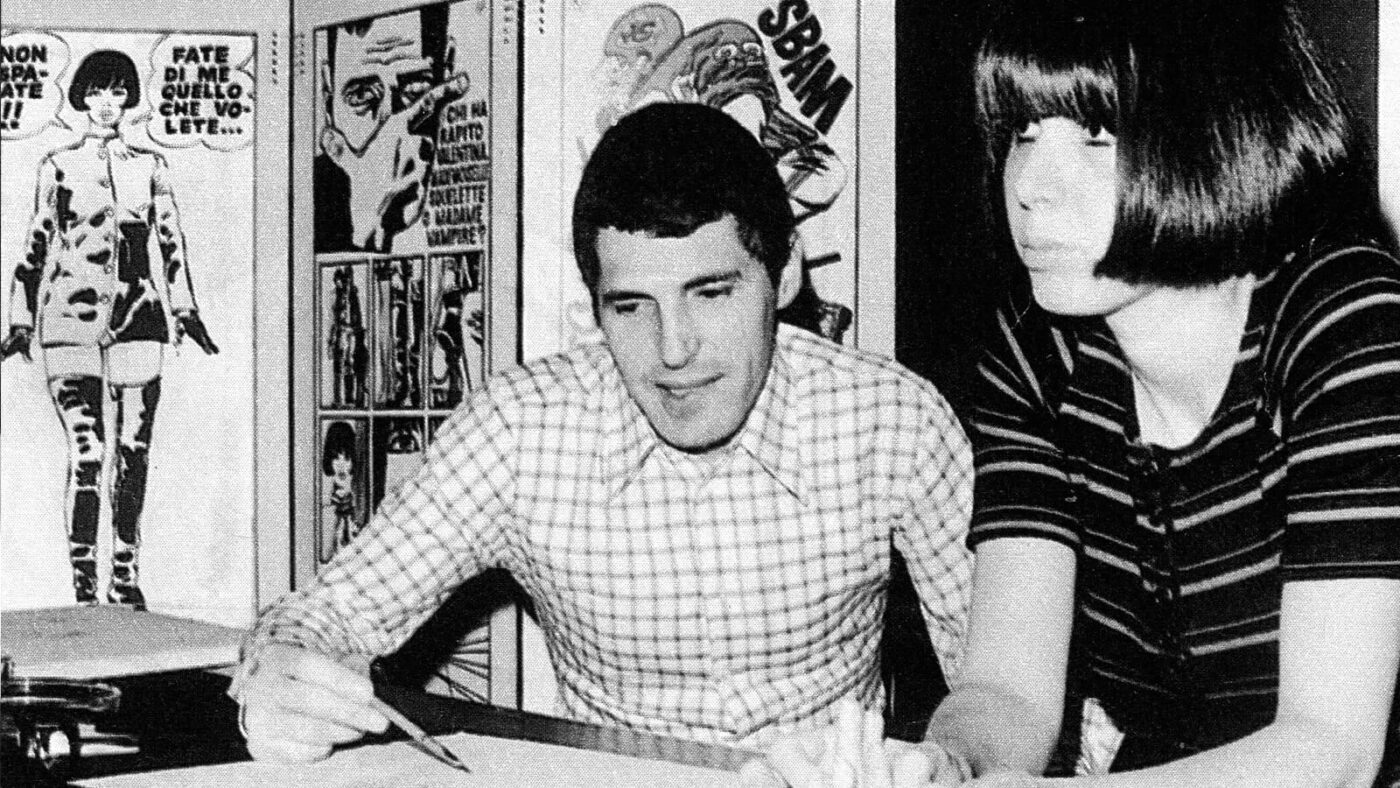
In total, he drew over 120 stories — around 4,500 comic plates — and his books have been published in more than 300 editions worldwide. Over forty years of work, he produced thousands of illustrations for newspapers, magazines, and books, as well as designing home furnishings, fabrics, fashion items, and design objects bearing his distinctive touch. He also worked in theatre, cinema, and television.
In the field of fine art graphics, he created more than one hundred lithographs and screen prints. Numerous solo exhibitions have been dedicated to him in Italy and abroad. Writers such as Roland Barthes, Alain Robbe-Grillet, Alain Resnais, Gillo Dorfles, Umberto Eco, and many others have written about him. Creating board games was his favourite pastime.
Guido Crepas, better known to the world as Crepax, was born in Milan on 15 July 1933 to Venetian parents. In 1945, at just twelve years old, he drew his first comic books inspired by films such as The Invisible Man, Dr Jekyll, and The Vampire. During his high school years, he refined his illustration style by drawing Wagnerian subjects and scenes from the novels of Jules Verne and the tales of Edgar Allan Poe. He also began creating his first board games, often with a sporting theme — a passion he shared with schoolmates and family friends including Claudio and Gabriele Abbado, Emilio Tadini, and Adriano De Zan.
While studying architecture at the Polytechnic University of Milan, and encouraged by his older brother Franco — already working as a record executive — he designed his first album cover in 1953, for a record by jazz pianist Fats Waller, produced by the label La Voce del Padrone. This marked the beginning of a prolific career that would lead to over three hundred album covers across various musical genres — from jazz to classical, Italian song to dance music — created for major Italian and international record companies.
It was thanks to these jazz covers, inspired by the American master David Stone Martin, that Crepax landed his first advertising commission: the Shell petrol campaign, which in 1957 won the Golden Palm for Advertising. He graduated in architecture the following year, in 1958, but soon dedicated himself entirely to drawing. In addition to his work for Shell (for which he also helped craft the ad copy), Crepax created advertising pages for companies such as Biraghi, Hanorah, Campari, Monier, Standa, and Rizzoli periodicals. Between 1962 and 1965, he also illustrated short stories by emerging women writers for the women’s magazine Novella. In the publishing world, between 1963 and 1964, he produced large colour plates for Le civiltà by Vallardi Editori and Per Voi Ragazzi by Mondadori; book covers for Piccola Biblioteca Ricordi, for school textbooks by Calderini and Loescher, and for pocket editions published by Bompiani, Garzanti, Sonzogno, and Sugarco.
In 1965, Crepax made his debut in the newly founded magazine Linus, directed by Giovanni Gandini (and supported by writers such as Umberto Eco and Elio Vittorini), with his first comic story, La curva di Lesmo. It introduced two characters: the art critic Phil Rembrandt and the photographer Valentina Rosselli — whose adventures and life he would narrate for the next thirty-five years.
After a first five-year period largely devoted to Valentina, between the late 1960s and early 1970s Crepax created other characters and stories: Belinda contro i mangiadischi (1967), set in the music world and serialised in the teen magazine Giovani; L’Astronave pirata (1968), published by Rizzoli and considered Italy’s first graphic novel alongside Hugo Pratt’s Una ballata del mare salato; U (1970), an Orwellian tale of a man in a world of beasts, published in the underground magazine Ubu; Bianca: la casa matta (1968–71), serialised in New Kent; La calata di Mac Similiano XXXVI (1969), published in Linus; and Anita: una storia possibile (1971), published in the comic magazine Sorry. Meanwhile, Valentina’s stories continued to appear in Linus and its supplements, later collected into volumes translated and published across almost all of Europe as well as in Japan, the United States, and South America.
Valentina’s adventures inspired both a feature film — Baba Yaga (1973), directed by Corrado Farina and starring Isabelle de Funès — and a TV series in 1989, featuring the American actress Demetra Hampton.
In 1973, Crepax created his first comic adaptation of another author’s novel: the scandalous Histoire d’O by Pauline Réage, published by Franco Maria Ricci in a luxurious, large-format edition that was widely criticised both for its content and its price. From that point onward, Crepax periodically returned to erotic literature: The Memoirs of Casanova (1976), Emmanuelle (1978), Justine (1979), and Venus in Furs (1983), followed by sequels to Histoire d’O (1984–85) and Emmanuelle (1990).
He also created numerous visual retellings of literary masterpieces: Count Dracula (1983) from Stoker, Dr Jekyll and Mr Hyde (1985–86) from Stevenson, The Turn of the Screw (1989) from James, The Trial (1997) from Kafka, and Frankenstein (1999) from Shelley — his final completed work. In his later years, afflicted by multiple sclerosis, he attempted to adapt several other novels, including Dream Story (Traumnovelle) by Arthur Schnitzler (2000), but was unable to finish them.
Across 35 years of creative activity, Crepax produced approximately 4,500 comic plates, and his books have been published in over 300 editions in major languages worldwide.
Crepax also worked in television — creating Carosello commercials and title sequences — as well as in cinema, collaborating with director Tinto Brass, and in theatre, designing sets and costumes for a play directed by Luigi Squarzina and, in 2000, the costumes for Alban Berg’s opera Lulu, directed by Mario Martone.
As a fine artist, he produced more than one hundred limited-edition works — including screen prints, lithographs, and etchings — and his art has been exhibited in dozens of shows in Italy and abroad. Critics such as Roland Barthes, Alain Robbe-Grillet, Alain Resnais, Achille Bonito Oliva, Gillo Dorfles, Oreste Del Buono, Umberto Eco, and Maurizio Fagiolo dell’Arco have written about his work.
In the advertising field, Crepax created a series of Carosello spots for Terital featuring the character Terry, as well as posters and print ads for the clothing company Nexam, which produced collections branded Robe de Valentina and Valentina Jeans, inspired by his iconic heroine. Staying true to his political ideals, he designed posters for the Trotskyist Fourth International, for extra-parliamentary leftist groups, and for non-profit organisations such as Amnesty International.
His favourite pastime was inventing and crafting board games — both as promotional items for advertising campaigns and for the delight of family and friends. Among these, about twenty faithfully recreated great historical battles, complete with miniature armies and detailed battlefields.